
The Steppes That Fueled a Continental Ritual
The Great Tea Road was not a single paved route, but a shifting chain of roads, river crossings, caravan stations, and frontier markets linking China with the Russian Empire and, through Russia, with the wider European world. At its northern hinge stood Kyakhta, the border settlement formalized by the 1727 treaty between Qing China and Russia. From there, tea moved north through Siberia toward Moscow and St Petersburg, a journey often described in broad terms as stretching roughly 10,000 miles when the full network of routes and distribution corridors is included. Its importance lay not simply in moving a fashionable beverage. The route connected imperial diplomacy, Mongolian intermediaries, Siberian logistics, and the daily routines of Russian households.
The contrast with Western European maritime commerce was decisive. European merchants increasingly relied on ships that could carry enormous quantities across oceans, even though voyages exposed cargoes to salt air, humidity, storms, insects, and the persistent odors of wooden holds and bilge water. The overland tea trade was slower, more expensive, and vulnerable to winter closures, yet its conditions could help protect compressed tea during transport. In Russia, where winter was not an occasional inconvenience but a governing fact of life, the arrival of tea also encouraged a distinctive domestic infrastructure. Hot water became a household necessity, and the samovar transformed that necessity into a durable ritual of warmth, sociability, and shared endurance. The broader history of Russian tea culture is inseparable from this samovar tradition.
Diplomatic Foundations of the Kyakhta Frontier Trade
The Kyakhta trade route rested on a diplomatic settlement as much as on geography. The 1727 Kyakhta Treaty followed the earlier Treaty of Nerchinsk in 1689 and attempted to regulate a relationship marked by military tension, contested frontiers, and mutual economic interest. Its provisions addressed border demarcation, official communications, the movement of authorized persons, extradition of fugitives, and commercial procedures. This was not a narrow customs agreement. It was an instrument of imperial statecraft, designed to make a difficult frontier governable.
For the Qing government, regulated commerce helped stabilize the northern frontier and reinforced control over movement through Mongolia. For Russia, the agreement offered a more secure basis for restoring and expanding trade with China. The diplomatic logic was practical: both empires wanted to limit disorder without eliminating the economic exchanges that made the border valuable. Research on the Nerchinsk and Kyakhta settlements emphasizes how trade arrangements were embedded in wider systems of border administration and peaceful dispute resolution, as discussed in this study of the treaties.
The commercial exchange was complementary but unequal in form. Russian merchants brought furs, leather, metals, textiles, and manufactured goods. Chinese traders supplied tea, silk, cotton, and other commodities, with pressed brick tea becoming especially important in the northern trade. Brick tea was compact, durable, and easy to divide or exchange. Its form suited a caravan economy in which cargo had to survive repeated loading, unloading, inspection, and transfer between different animals and vehicles.
- Russian exports included furs, leather, metal goods, and manufactured products.
- Chinese exports included tea, silk, cotton, and other finished goods.
- Mongolian intermediaries and caravan operators connected frontier markets with distant consumers.
- Tea was commonly compressed into bricks or cakes that reduced bulk and improved durability.
The physical journey remained punishing. Caravans crossed frozen ground, open steppe, river routes, and stretches where roads were little more than tracks remembered by experienced drivers. Animals needed fodder, water, rest, and protection from sudden weather. In winter, cold could preserve cargo but also immobilize a caravan; in warmer seasons, mud, flooding, and damaged roads created different hazards. The route”s survival therefore depended on accumulated local knowledge and on a chain of political agreements, market towns, inns, and supply points. The geography of Mongolia, positioned between the Russian and Chinese spheres, continues to demonstrate how landlocked spaces can become both strategic corridors and zones of vulnerability, a point explored in this geopolitical analysis of Mongolia.
Caravans Versus Galleons and the Chemistry of Overland Tea
The difference between overland and maritime transport shaped the character of the tea that reached Russian consumers. Ocean shipping offered scale, but the environment inside a ship”s hold was unstable. Cargo could encounter damp air, condensation, seawater, and odors from ropes, timber, food stores, and bilge compartments. Loose or delicate tea leaves were particularly vulnerable to moisture and contamination. Maritime tea therefore required careful packaging, and its eventual taste could reflect not only the origin of the leaf but also the conditions of the voyage.
Overland carriage was not automatically superior, and the claim that every caravan shipment possessed a uniquely smoky flavor should be treated cautiously. Yet dry air and freezing temperatures could limit some forms of deterioration. Compressed tea was protected against abrasion and was less exposed than loose leaf. The route”s slower pace also allowed trading communities to develop preferences for robust teas capable of withstanding long storage. Taste was consequently produced by a combination of cultivation, processing, packaging, transport, and preparation. The history of tea vessels confirms that trade routes repeatedly reshaped local habits, from Chinese clay teapots to specialized regional forms, as documented by the Victoria and Albert Museum.
| Feature | Maritime corridors | Kyakhta overland corridors |
|---|---|---|
| Typical advantage | High carrying capacity and lower unit costs over long sea distances | Direct access to inland markets and strong control over small, valuable cargoes |
| Primary hazards | Humidity, storms, seawater, pests, and shipboard odors | Extreme cold, poor roads, animal losses, banditry, and seasonal closures |
| Tea packaging | Crates and chests suited to shipboard storage | Compressed bricks or cakes suited to repeated handling |
| Speed and scale | Slower by sea but capable of moving very large volumes | Slower and more expensive, with many transfers and limited loads |
| Consumer effect | Encouraged mass importation through port cities | Supported distinctive inland preferences and frontier distribution networks |
Caravan trade also belonged to a much older Eurasian pattern. Long-distance routes rarely operated as one uninterrupted road. Goods changed hands at markets, with camels, horses, mules, oxen, yaks, and porters used according to terrain. High freight costs favored commodities that were valuable, durable, and relatively compact. Tea met those requirements unusually well, especially when pressed into bricks. The route was therefore a flexible network rather than a straight line, responding to political decisions, weather, river conditions, and the changing availability of pasture and provisions.
Engineering the Hearth into an Emblem of Domestic Warmth
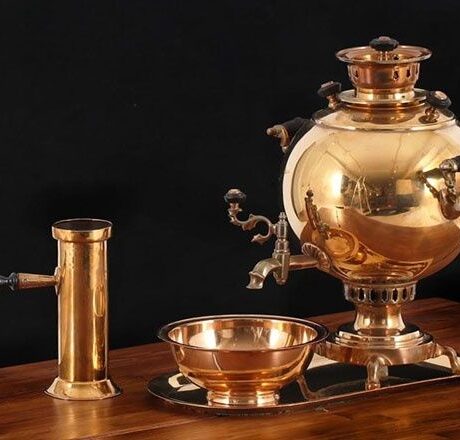
The samovar emerged from this logistical and climatic environment as a piece of practical engineering. Earlier households could heat water in kettles or pots, but the samovar combined a water reservoir, a tap, a chimney-like central fuel pipe, and a support for a small teapot. Fuel burned inside the vertical pipe, transferring heat to the surrounding water. The design created a stable supply of near-boiling water while allowing the concentrated tea infusion, known as zavarka, to remain warm above the vessel.
Its efficiency was especially valuable in a cold climate. Charcoal could provide sustained heat with relatively little attention, while pinecones and small pieces of wood offered accessible alternatives in rural settings. The samovar did not need to boil an entire household”s water repeatedly on a stove. Once heated, it could maintain warmth for an extended period, reducing interruptions during meals, business discussions, religious visits, or evening gatherings. Brass and copper models conducted heat effectively, while their polished surfaces also made them visible symbols of order and prosperity.
- The central fuel pipe concentrated heat beneath the water reservoir.
- Charcoal provided steady, long-lasting heat.
- Pinecones and wood made the system adaptable to local fuel supplies.
- A tap allowed individual cups to be filled without moving the vessel.
- The teapot above the samovar held strong zavarka for gradual dilution.
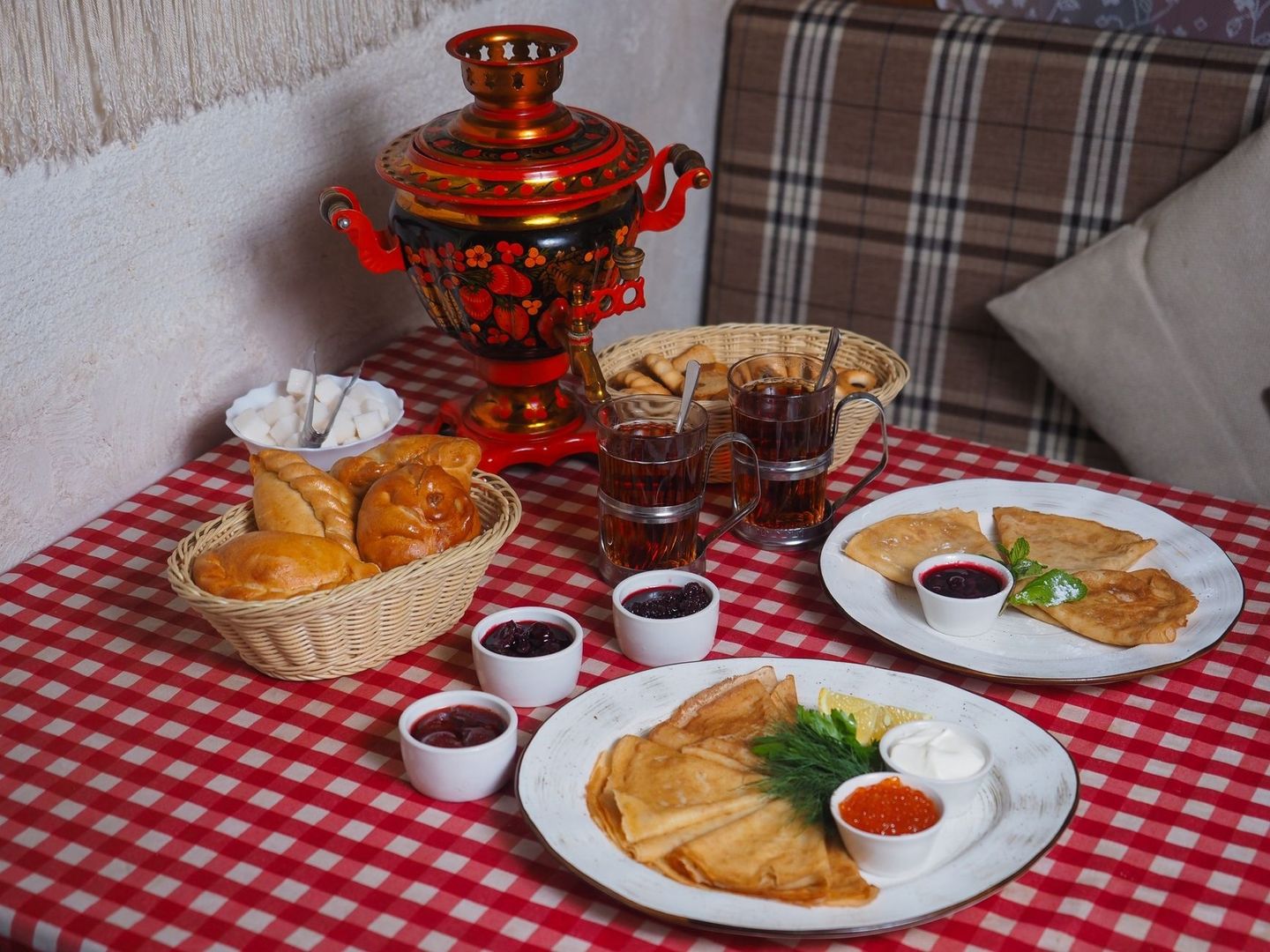
The method of preparation supported different levels of wealth. A small amount of strong tea was brewed in the upper pot, then diluted with hot water according to taste. Wealthier households could serve refined leaves, sugar, lemon, preserves, and elaborate pastries. Poorer households could stretch a modest supply of tea across many cups. The samovar therefore joined economy and hospitality. It made tea ceremonially important without requiring every cup to contain a large quantity of leaf. Its function was both metallurgical and social: heat was generated below, while conversation and social exchange accumulated around it.
Democratization of Hospitality Across Continental Divides
Tea entered Russian life as an expensive import associated with courts, merchants, and urban elites. Over time, expanding trade and industrial production reduced its exclusivity. The shift did not make tea cheap for everyone at once, nor did it erase regional differences, but it transformed tea from a rare luxury into a regular part of domestic life for merchants, artisans, peasants, and city residents. The samovar was central to this transition because it made serving tea a collective household process rather than an occasional display of elite refinement.
The steaming urn also reorganized the social meaning of hospitality. Guests were not merely offered a beverage; they were invited into a setting structured by waiting, refilling, dilution, and conversation. The host controlled the strength of the zavarka, while guests could adjust their cups with hot water and sugar. In this respect, the samovar softened some domestic hierarchies without abolishing them. A household”s wealth remained visible in the vessel”s materials, ornament, and accessories, yet the basic ritual could be reproduced with inexpensive brass models as well as aristocratic silver examples.
- Water was heated in the samovar until it reached a sustained near-boil.
- Strong zavarka was prepared in the small pot positioned above the reservoir.
- Each cup received a measured amount of concentrate.
- Hot water was drawn from the tap and used to adjust strength and temperature.
- Tea was extended through conversation, food, refills, and the continued presence of guests.
The samovar”s cultural reach extended beyond the Russian Empire. Migrants carried vessels, recipes, and memories across borders, including families who left the empire in the late nineteenth and early twentieth centuries. A samovar could function as household equipment, inheritance, and portable evidence of origin. Its presence in a new country helped reconstruct a familiar social world around an unfamiliar table. Later, even when electric kettles made the original fuel system unnecessary, the object retained symbolic force. Museums and cultural institutions continue to describe it as a marker of Russian sociability, nostalgia, and hospitality, while historical accounts note that Soviet authorities first criticized its bourgeois associations before adapting and mass-producing the form for a wider population.
Echoes of the Great Road in Modern Living
The history of the Great Tea Road reveals how international politics can settle into the smallest domestic objects. A treaty negotiated by imperial officials at a remote frontier established conditions for commerce. Geography imposed its demands through cold, distance, and limited infrastructure. Merchants responded with durable packaging and specialized supply chains. Metalworkers then translated the need for reliable hot water into a vessel that became an emblem of the household. The tea table was therefore the final stage of a process that began with border regulation and caravan logistics.
The samovar”s lasting significance lies in this convergence. It represents adaptation to severe conditions, but also the decision to make endurance social. Its heat supported conversation, hospitality, and continuity across class, region, and migration. Modern communal spaces still reproduce elements of the same logic through shared coffee urns, workplace kettles, neighborhood kitchens, and long tables where beverages create a reason to remain together. The roads have changed, and the fuel has often become electric, but the central lesson survives: material culture carries geopolitical history into ordinary life, where distant treaties and difficult landscapes can persist in the warmth offered to a guest.
